
For banks, swales and ditch lines
Slope & Erosion Control in Omaha, NE
Cover that holds loess soil in place until grass roots can take over.
- Site walk and a written estimate at no charge
- Seed blends picked for eastern Nebraska cool-season lawns
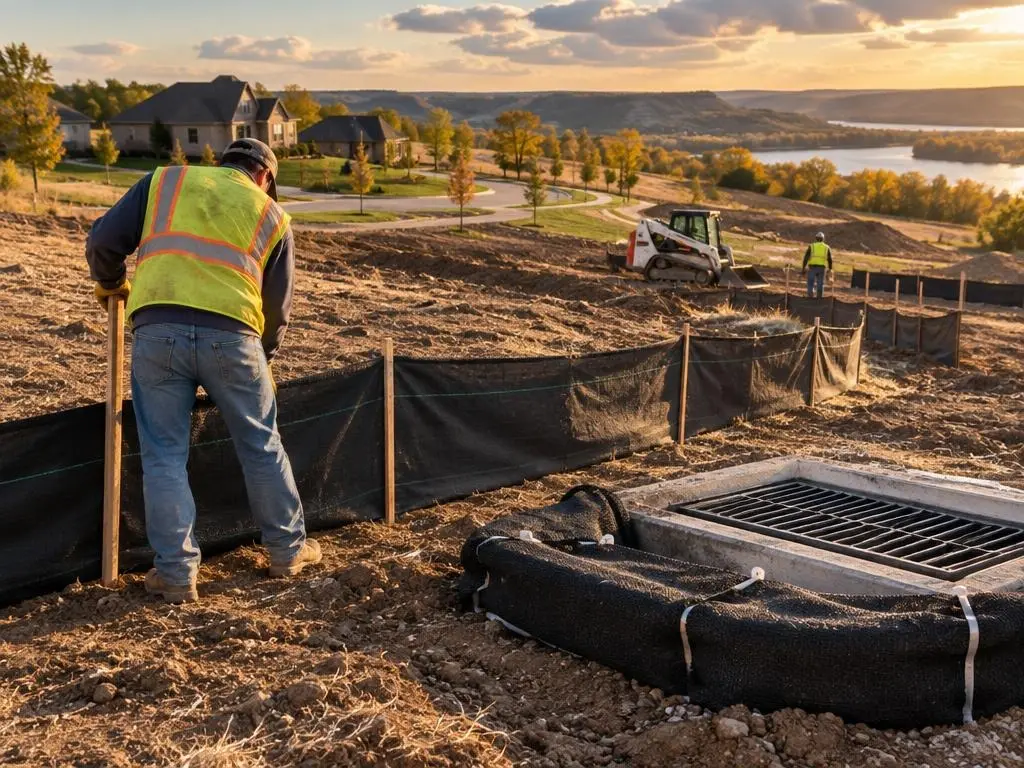
- Silt fence and inlet protection priced as their own line items
Keeping Loess Where It Belongs
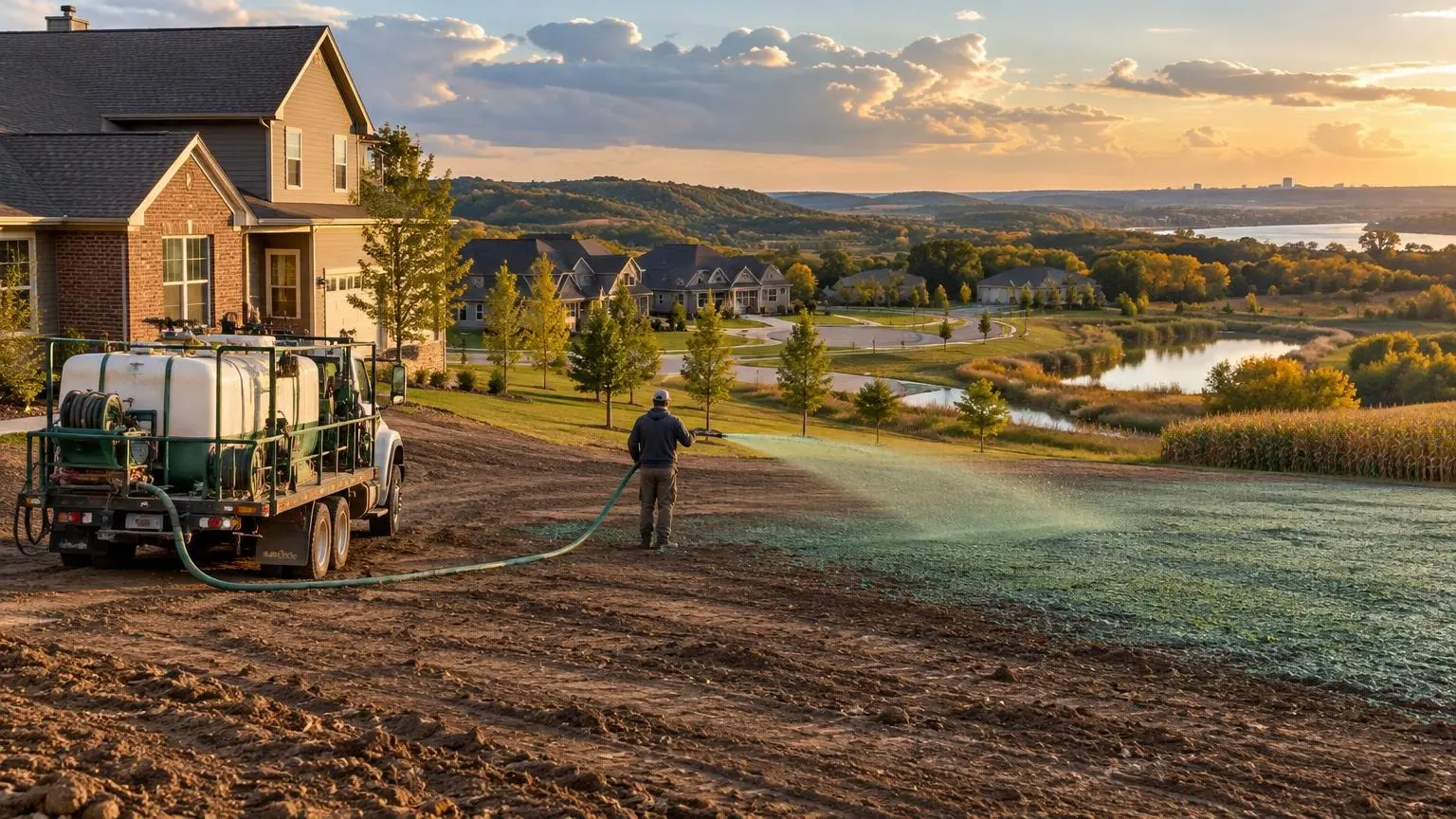
Slope and erosion control in Omaha starts with the soil. The bluffs and rolling uplands around the city are loess, wind-laid silt and fine sand with little clay. Loess is known for standing in steep or even vertical faces for years while it is covered, and for washing badly once it is bare: even well-managed loess farmland can lose a lot of soil every year. A new walkout lot, a cut behind a retaining wall, a drainage swale between two houses or a ditch along an acreage drive can all lose inches of soil in a single summer thunderstorm. Our job is to cover that ground quickly and keep it covered until grass roots hold it.
Matching the cover to the slope
There is no one product for every bank. On gentle slopes, a standard hydroseed coat with tackifier holds well. As the grade gets steeper or longer, or water starts to concentrate, we step up:
- Heavier hydromulch rates for moderate slopes and the faces of berms.
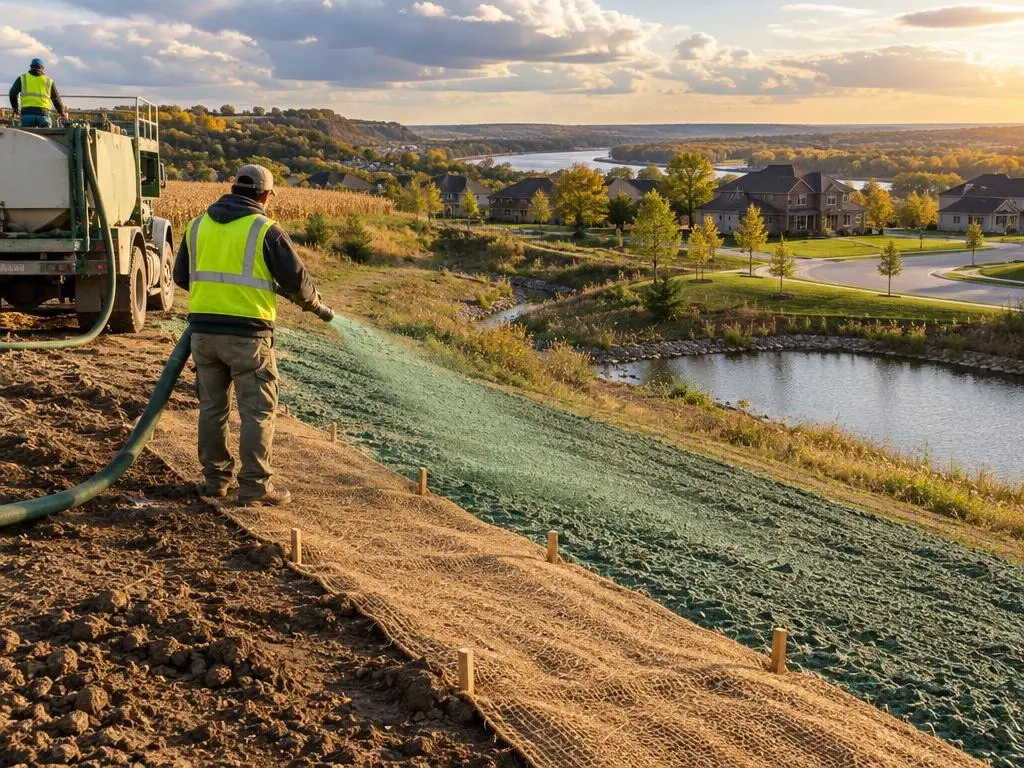
- Bonded fiber matrix (BFM) hydraulic mulch, which forms a continuous mat when it cures, for steep banks where a blanket is hard to anchor or the surface is rough.
- Straw blankets (erosion control blankets made of straw) stapled over seed on slopes and in low-flow swales.
- Straw-coconut or coir blankets where water runs harder or the cover has to last longer.
We choose by the grade, the length of the slope, how much water comes from above, and how soon the area will see traffic or mowing.
Swales and drainage paths
Most erosion we see is not on the steep part of a yard but in the low line where water collects. A side-yard swale between two new homes, or the path a downspout takes across the lawn, carries more water than the surrounding slope. Seed in those lines needs a blanket, and sometimes the swale needs reshaping first so water spreads instead of cutting a channel. We look at where water comes from, not just where it leaves.
Omaha weather and timing
Eppley Airfield's 1991 to 2020 normals show more than four and a half inches of precipitation in each of May, June and August, and the humid summers bring frequent thunderstorms. Those are the months bare slopes fail. The cool-season seeding window Nebraska Extension recommends for eastern Nebraska runs August 15 to September 15, and that is still the best time to grow grass on a slope. If a bank cannot wait, we can blanket it in early summer and accept that the seed will need more watering to get through the heat.
Erosion control services for builders and acreages
On construction sites, erosion control is part of the stormwater plan: stabilizing disturbed slopes is one of the practices that keeps sediment out of inlets and the Papillion Creek system. On rural acreages north and west of the city, it is often a road ditch, a pond dam face or a terrace that keeps slumping. The tools are the same; the scale is different. As erosion control contractors we work with builders, site contractors and homeowners, and we price blankets and mulch so you can compare them line by line.
Slope stabilization limits
Seed, mulch and blankets protect the surface. They do not stop a slope that is sliding because of water inside it, a wall that is failing, or a cut that is simply too steep for the soil. If we see slumping, tension cracks, seeps or a bulging wall, we will tell you that the fix is drainage or engineering first, and seeding second.
Native grass on banks
For long slopes that will not be mowed, such as the back of a lot facing a creek or the side of a pond, a native grass mix under a blanket can make more sense than turf. It is slower to establish, but once it takes it needs far less care. We can talk through that option during the site visit.
Keying in a blanket
A blanket is only as good as its top edge. If water gets under the upslope end, it lifts the whole run and carries seed and soil out the bottom. We bury the top of each roll in a small trench, staple it closed, overlap the rolls shingle-style so water flows over the seams rather than into them, and staple the body of the blanket at the spacing the maker calls for, closer on steep ground. In swales, rolls run in the direction of flow, with check slots where the channel is long. The seed and fertilizer go down before the blanket, not on top of it, so the seedlings come up through the fiber and root into the soil. That is slower than spraying mulch on a bank, but on a slope that has already failed once, it is the part of the job that keeps us from coming back.
Erosion Control Options
What we put on slopes and drainage lines.
Straw erosion control blankets
Single-season blankets stapled over seed on moderate slopes and low-flow swales.
Straw-coconut and coir blankets
Longer-lasting blankets for steeper banks and harder-running water.
Hydro mulching at heavier rates
Extra fiber mulch on berms and moderate slopes for more surface cover.
Bonded fiber matrix
Hydraulic mulch that cures into a continuous mat on steep or rough banks.
Swale reshaping and seeding
Low lines regraded to spread water, then seeded and blanketed.
Ditch and pond bank cover
Seeding and blankets for acreage ditches, dam faces and shorelines.
Published Erosion Control Ranges
| Item | Published price |
|---|---|
| 70/30 straw-coir blanket, installed, each 1,000 sq ft (a 2025 DOT unit-cost table) | $468 |
| All-coir blanket, installed, each 1,000 sq ft (same list) | $532 |
| Sprayed wood fiber mulch, each 1,000 sq ft (same list) | $98 |
| Hand-spread straw mulch, per 1,000 square feet (same list) | $170 |
| Steep-slope surcharge on residential hydroseeding, per sq ft (HomeGuide) | add $0.05 to $0.10 |
| Bonded fiber matrix | Quoted once we see the site |
Agency rate-schedule prices are installed reference figures, not Omaha quotes. No current published price was found for bonded fiber matrix. Averages only. Your written estimate from us sets the bill.
How We Handle a Slope
1. Look upslope
Find where water comes from and whether the slope is moving or just washing.
2. Repair the surface
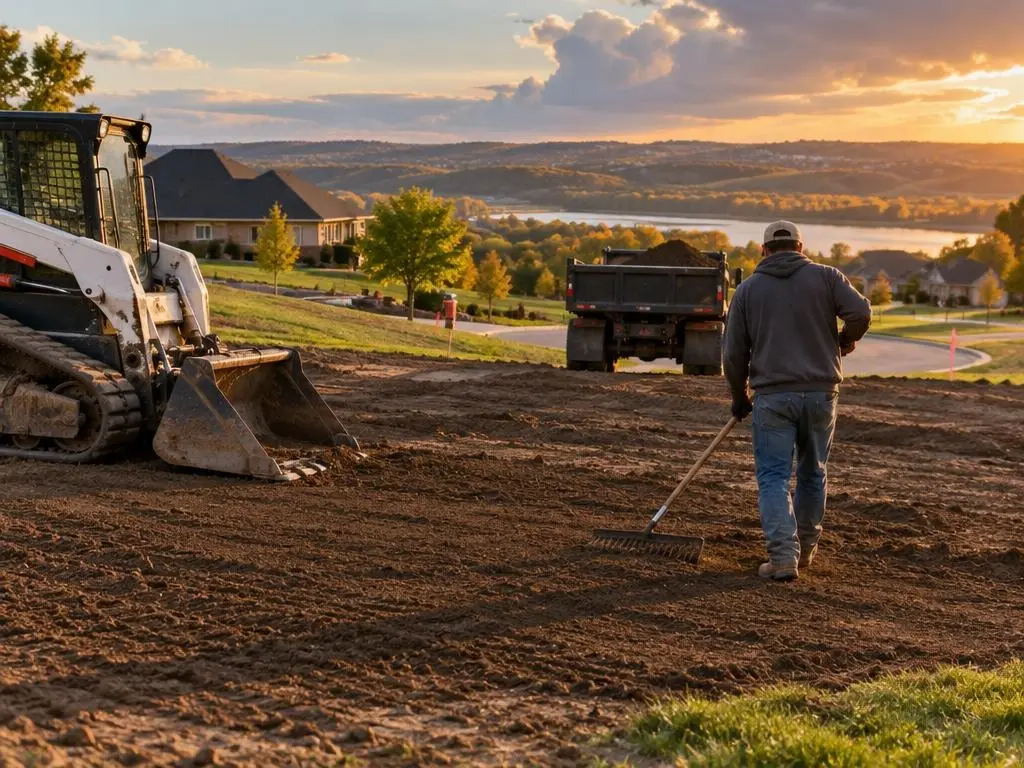
Fill rills, smooth the face and reshape swales so water spreads.
3. Seed
Hydroseed or hand seed with a mix suited to sun, shade and mowing.
4. Cover
Heavier hydromulch, BFM or blankets stapled in and keyed at the top.
5. Check after storms
Call us after the first big rain if anything moved; small fixes are quick.
Why Choose Us for Slope & Erosion Control
Cover picked by grade
We do not put a blanket where mulch will do, or mulch where a blanket is needed.
Honest about failures
If the slope needs drainage or a wall, we say so before selling seed.
Builder and acreage work
From one side-yard swale to a long ditch line.
Slope & Erosion Control Questions
Are erosion control blankets better than hydromulch?
On steeper slopes and in swales that carry water, yes. On gentle ground, hydromulch is usually enough and costs less. Many slopes get both: seed and mulch underneath, a blanket on top.
Do blankets have to be removed?
Straw and coir blankets break down over one or more seasons while the turf roots through them. Certain types are made with plastic netting; we can use netting-free types near areas with wildlife or where you plan to mow soon.
Why does my slope keep washing even after seeding?
Usually water is concentrating from above, from a downspout, a neighbor's yard or a driveway. Until that flow is spread out or redirected, seed alone will not hold. We look for the source on the visit.
Can you seed a slope in summer?
Yes, with a blanket and steady watering, but August to mid-September is the stronger window in eastern Nebraska. A summer blanket protects the soil even if the grass is slow.
Slope & Erosion Control Service Areas
- Hydroseeding in Omaha, NE
- Hydroseeding in Bellevue, NE
- Hydroseeding in Papillion, NE
- Hydroseeding in La Vista, NE
- Hydroseeding in Gretna, NE
- Hydroseeding in Elkhorn, NE
- Hydroseeding in Council Bluffs, IA
- Hydroseeding in Ralston, NE
- Hydroseeding in Springfield, NE
- Hydroseeding in Blair, NE
- Hydroseeding in Fremont, NE
- Hydroseeding in Plattsmouth, NE
- Hydroseeding in Valley, NE
- Hydroseeding in Glenwood, IA
- Hydroseeding in Ashland, NE
- Hydroseeding in Carter Lake, IA
- Hydroseeding in Fort Calhoun, NE
- Hydroseeding in Crescent, IA
- Hydroseeding in Waterloo, NE
- Hydroseeding in Missouri Valley, IA
Get a Slope & Erosion Control Estimate
Free slope and swale assessments around Omaha.