
Missouri River Valley city
Hydroseeding in Omaha, NE
New lawns, lawn repair and sediment control on ground that has been cut, filled and regraded.
- Site walk and a written estimate at no charge
- Seed blends picked for eastern Nebraska cool-season lawns
- Silt fence and inlet protection priced as their own line items
Growing Grass on Reworked Omaha Ground
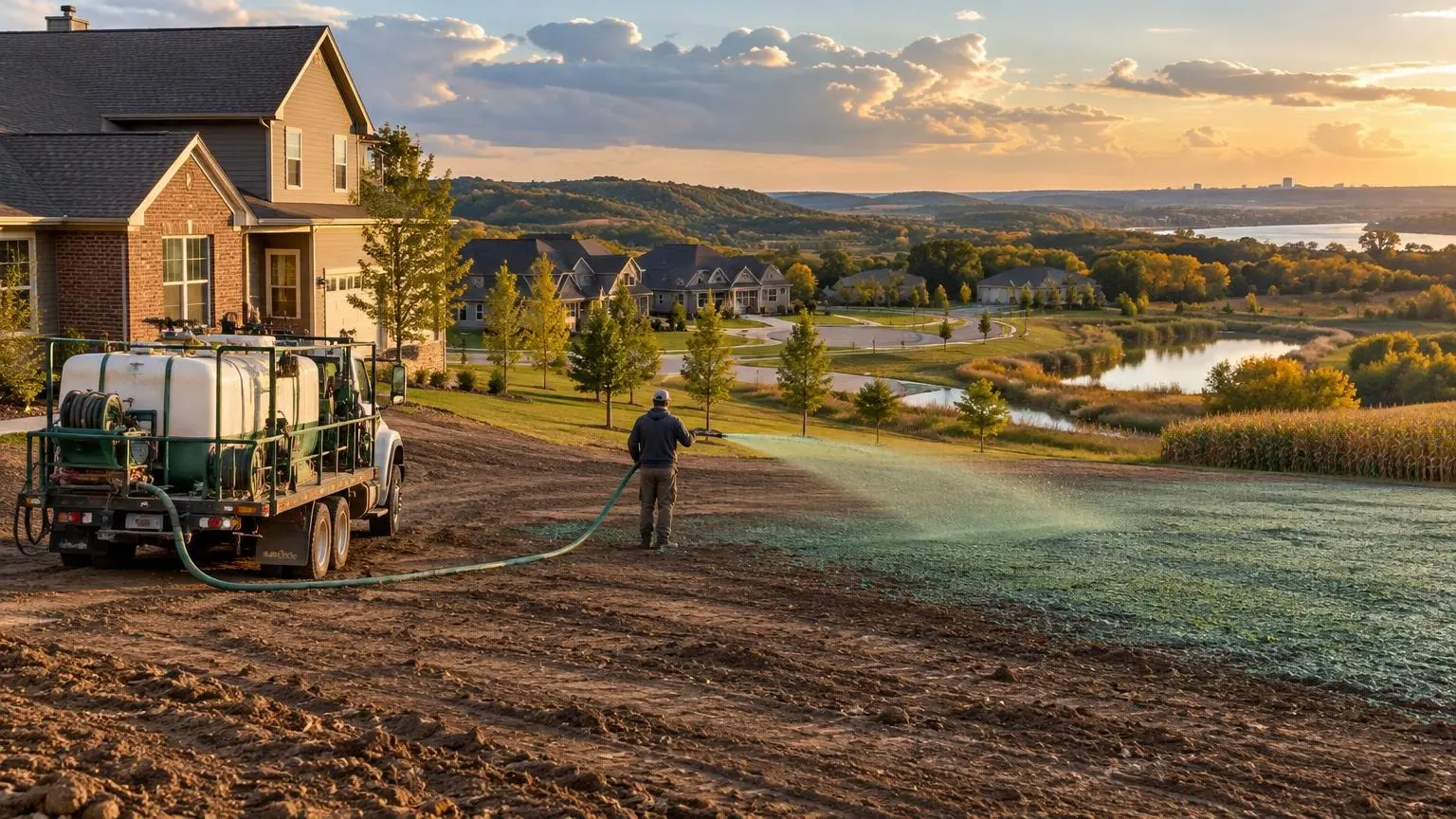
Hydroseeding in Omaha means working with ground that has been moved around a lot. Much of the city is built in the Missouri River Valley, and its land has been altered considerably by grading, both throughout downtown and in pockets scattered across town. A yard that sits on cut or fill rarely has the same soil from one corner to the other, so we look at what is actually on top before we mix a tank of seed, hydromulch and starter fertilizer.
Where the new lawns are
Since the 1970s Omaha has grown mostly onto open land to the west, and West Omaha is now home to the majority of the city's residents. That is where most bare-dirt lots show up: new homes, business parks and the strips around them after the builder's grading crew leaves. Hydroseed suits those lots because it covers a big, irregular area evenly and costs far less than sod over the same footage. On fresh subdivisions we also run silt fence across the downslope side and guard street inlets until grass is up, because a summer thunderstorm on bare grade moves a lot of soil into the gutter.
The Papio dams
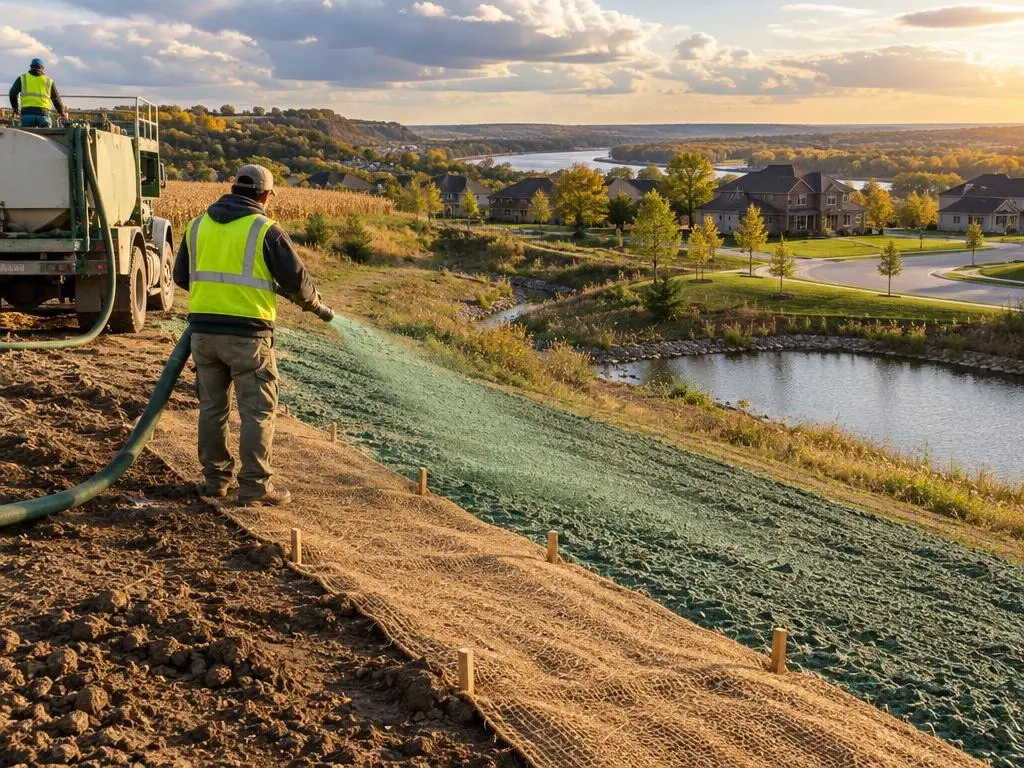
After damaging floods in 1964 and 1965, dams were built on Papillion Creek and its tributaries for flood control. Standing Bear Lake, also called Dam Site 16, opened as a park in 1977, and Zorinsky Lake Park opened in 1993. Both now sit among housing developments in West Omaha. Lots that drain toward those creeks and reservoirs are where we take sediment control most seriously, with a straw blanket or a heavier hydromulch rate on any swale that carries water off the property.
Seeding around Omaha weather
Eppley Airfield's 1991-2020 normals show about 32 inches of precipitation a year, with May, June and August each between roughly 4.4 and 4.7 inches. A typical summer brings about 29 days that reach 90 degrees or above, and January averages in the low 20s. That gives two good windows for cool-season seed: late August into September, and spring once the ground can be worked. Midsummer seeding is possible with steady watering, but we will tell you plainly when a fall date is the smarter call.
Older parts of town
North, South and Midtown Omaha are full of established yards rather than new grade. There the work is lawn repair: thin turf, bare spots under trees, ruts left from a sewer or water line dig. We loosen and level the soil, add topsoil where it is needed and hydroseed or overseed the patch until it matches the surrounding turf.
Send us the address and a rough size of the area. Get a free estimate or call (402) 704-4105.
Omaha Ground and Weather Notes
- Graded city. Omaha's land has been altered considerably by land grading, throughout downtown and scattered across the city.
- Westward growth. Since the 1970s Omaha has expanded mostly onto available land to the west, and West Omaha holds the majority of residents.
- Flood-control lakes. Dams on Papillion Creek and its tributaries, including Standing Bear and Zorinsky lakes, followed the floods of 1964 and 1965.
- Warm-season rain. Eppley Airfield averages about 32 inches of precipitation a year (1991-2020), falling mostly in the warmer months.
Omaha Questions
Is fall or spring better for seeding a lawn in Omaha?
Late summer into early fall usually wins: warm soil, cooler nights and less weed pressure. Spring works too, but May and June are among the wettest months, so fresh grade needs more protection.
My West Omaha lot drains toward a creek. Does that change anything?
Yes. We put silt fence or wattles along the low side and use a blanket or a heavier mulch rate in any swale, so soil stays on your lot instead of washing toward the Papio system.
Can you fix just the strip torn up by a utility dig?
Yes. We level the trench, add topsoil if the backfill is clay or rubble, and hydroseed the strip so it fills in with the surrounding yard.
How hot is too hot to hydroseed in Omaha?
We can seed in summer, but with about 29 days a year at 90 degrees or more, seedlings need water every day. If you cannot keep up with that, waiting for late August is usually wiser.
Free Estimates in Omaha, NE
Free estimates for Omaha lawns, lots and slopes.
Hydroseeding Near Omaha
- Hydroseeding in Bellevue, NE
- Hydroseeding in Papillion, NE
- Hydroseeding in La Vista, NE
- Hydroseeding in Gretna, NE
- Hydroseeding in Elkhorn, NE
- Hydroseeding in Council Bluffs, IA
- Hydroseeding in Ralston, NE
- Hydroseeding in Springfield, NE
- Hydroseeding in Blair, NE
- Hydroseeding in Fremont, NE
- Hydroseeding in Plattsmouth, NE
- Hydroseeding in Valley, NE
- Hydroseeding in Glenwood, IA
- Hydroseeding in Ashland, NE
- Hydroseeding in Carter Lake, IA
- Hydroseeding in Fort Calhoun, NE
- Hydroseeding in Crescent, IA
- Hydroseeding in Waterloo, NE
- Hydroseeding in Missouri Valley, IA