
Front range of the Loess Hills
Hydroseeding in Council Bluffs, IA
Seeding and slope work on wind-built hills that turn soft when wet.
- Site walk and a written estimate at no charge
- Seed blends picked for eastern Nebraska cool-season lawns
- Silt fence and inlet protection priced as their own line items
Seeding the Loess Hills Edge
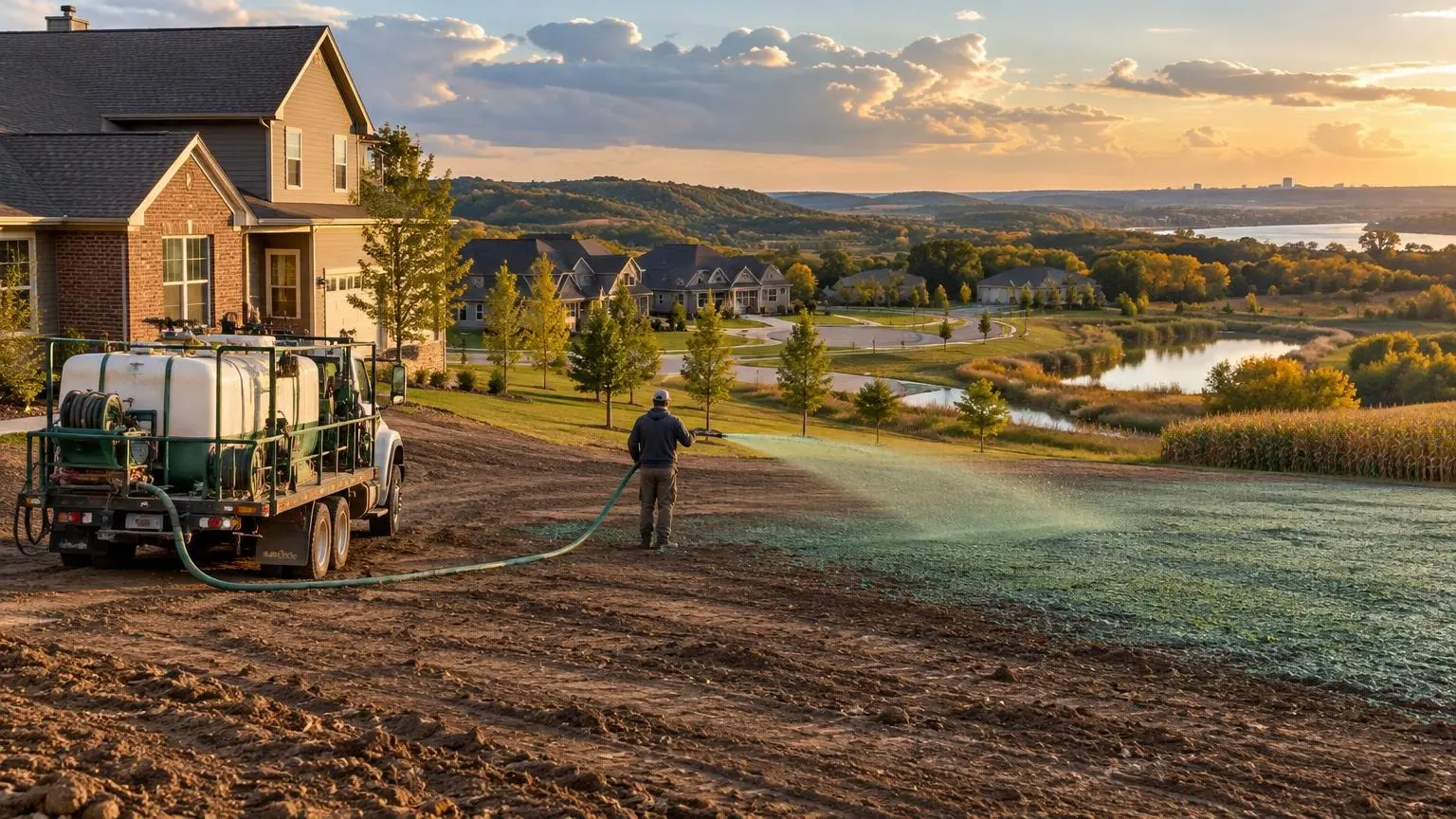
Hydroseeding in Council Bluffs means dealing with two very different kinds of ground. The city covers a region that was originally prairie and savanna in the Loess Hills, with extensive wetlands and deciduous forest along the Missouri River. Up on the hills the soil is loess, a fine wind-blown silt. Down by the river it is low, flat and often wet.
Why loess is tricky
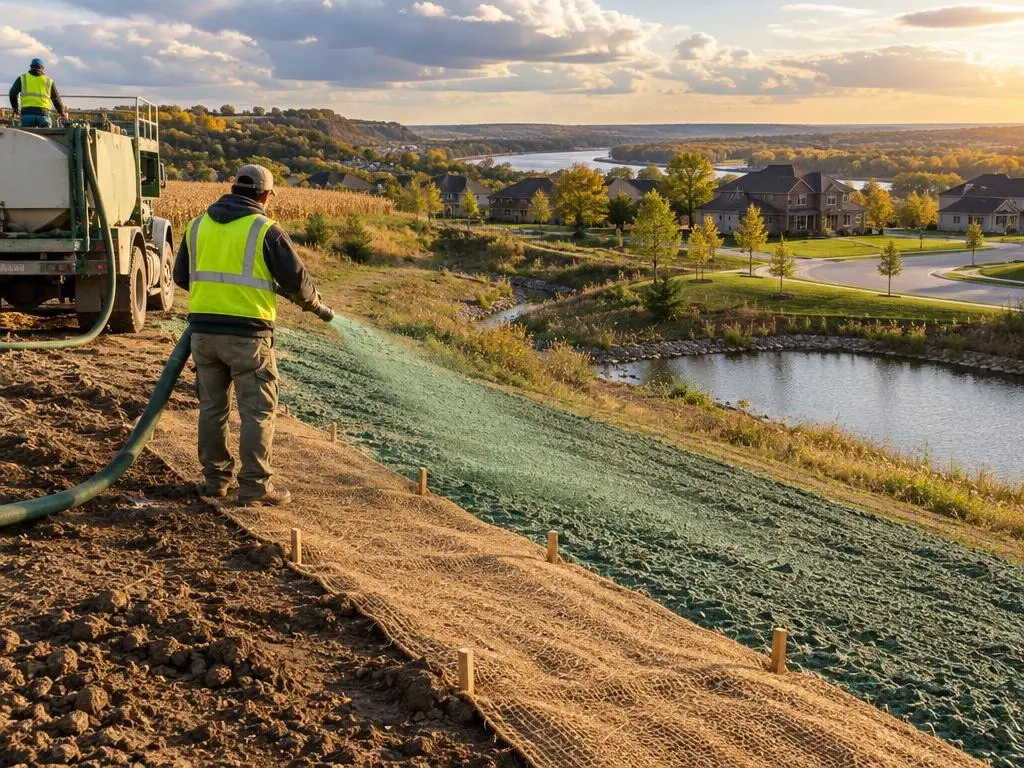
Loess was laid down after the last Ice Age, when strong westerly winds picked up silt from drying Missouri Valley mud flats. Locals call it sugar clay: it can be extremely hard when dry and loses its cohesion when it gets wet. That is why the hills erode into sharp ridges and cat-step terraces. A bare loess cut can gully in a single storm, so on slopes we skip plain mulch in favor of rolled blankets or a sprayed bonded fiber matrix, and we shape the top of the slope so water does not pour over the edge.
Hills that rise fast
The Loess Hills generally stand up to about 200 feet above the floodplain in a narrow band roughly 200 miles long. In Council Bluffs that shows up as steep back yards, terraced lots and driveways cut into hillsides. We look at where downspouts and driveway runoff go before anything else; a slope that takes a whole roof's worth of water in one spot will not hold seed no matter what goes on it.
River-made lakes
Lake Manawa, at the southern edge of the city, was created by Missouri River flooding in the late 1800s. The low ground around it and along the river holds water. There the work is usually lawn installation on flat ground, with a wet-tolerant grass blend and grading that moves water toward a ditch or drain.
Native grass where it fits
The hills still hold remnants of native prairie with big and little bluestem, Indian grass and sideoats grama. On acreages and slopes you do not plan to mow, a native mix sprayed with hydromulch suits the ground and needs far less water once established.
Get a free estimate or call (402) 704-4105 for Council Bluffs and Pottawattamie County.
Council Bluffs Soil and Terrain
- Loess Hills setting. Council Bluffs covers prairie and savanna in the Loess Hills, with extensive wetlands and deciduous forest along the Missouri.
- Sugar clay. Loess is known locally as sugar clay: extremely hard when dry, it loses all cohesion when wet.
- Lake Manawa. Lake Manawa, at the city's southern edge, was created by Missouri River flooding in the late 1800s.
- Hill height. The Loess Hills rise about 200 feet above the flat plains in a narrow band about 200 miles long.
Council Bluffs Questions
Will hydroseed hold on a steep loess slope?
Not with standard mulch alone. Steep loess gets a bonded fiber matrix or blankets pinned to the slope, plus a fix for any water arriving from above.
Why does my hillside keep washing out?
Loess loses strength when wet, so concentrated runoff cuts it quickly. Spreading or redirecting that water is usually half the repair.
Do you plant native prairie grass?
Yes, on slopes and acreages that will not be mowed like a lawn. It takes longer to establish but roots deeply.
Do you work on the Iowa side of the river?
Yes, Council Bluffs and nearby Pottawattamie County are part of our area.
Free Estimates in Council Bluffs, IA
Free estimates in Council Bluffs.
Hydroseeding Near Council Bluffs
- Hydroseeding in Omaha, NE
- Hydroseeding in Bellevue, NE
- Hydroseeding in Papillion, NE
- Hydroseeding in La Vista, NE
- Hydroseeding in Gretna, NE
- Hydroseeding in Elkhorn, NE
- Hydroseeding in Ralston, NE
- Hydroseeding in Springfield, NE
- Hydroseeding in Blair, NE
- Hydroseeding in Fremont, NE
- Hydroseeding in Plattsmouth, NE
- Hydroseeding in Valley, NE
- Hydroseeding in Glenwood, IA
- Hydroseeding in Ashland, NE
- Hydroseeding in Carter Lake, IA
- Hydroseeding in Fort Calhoun, NE
- Hydroseeding in Crescent, IA
- Hydroseeding in Waterloo, NE
- Hydroseeding in Missouri Valley, IA